
Last updated August 25, 2026
Free on-site gate assessment - hinges, posts, and your LiftMaster or Nice gate operator checked before anything is quoted
The assessment is free and the quote is the invoice.


 Before
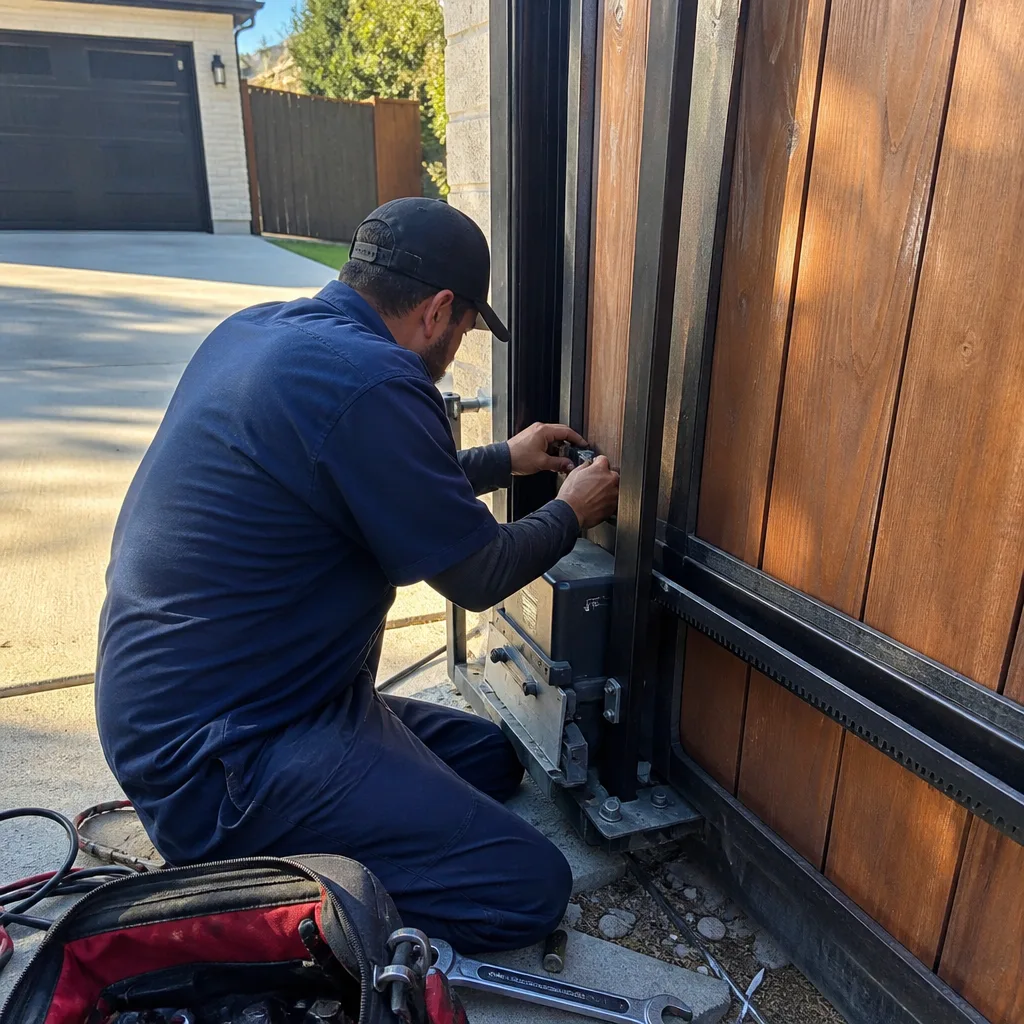 After
After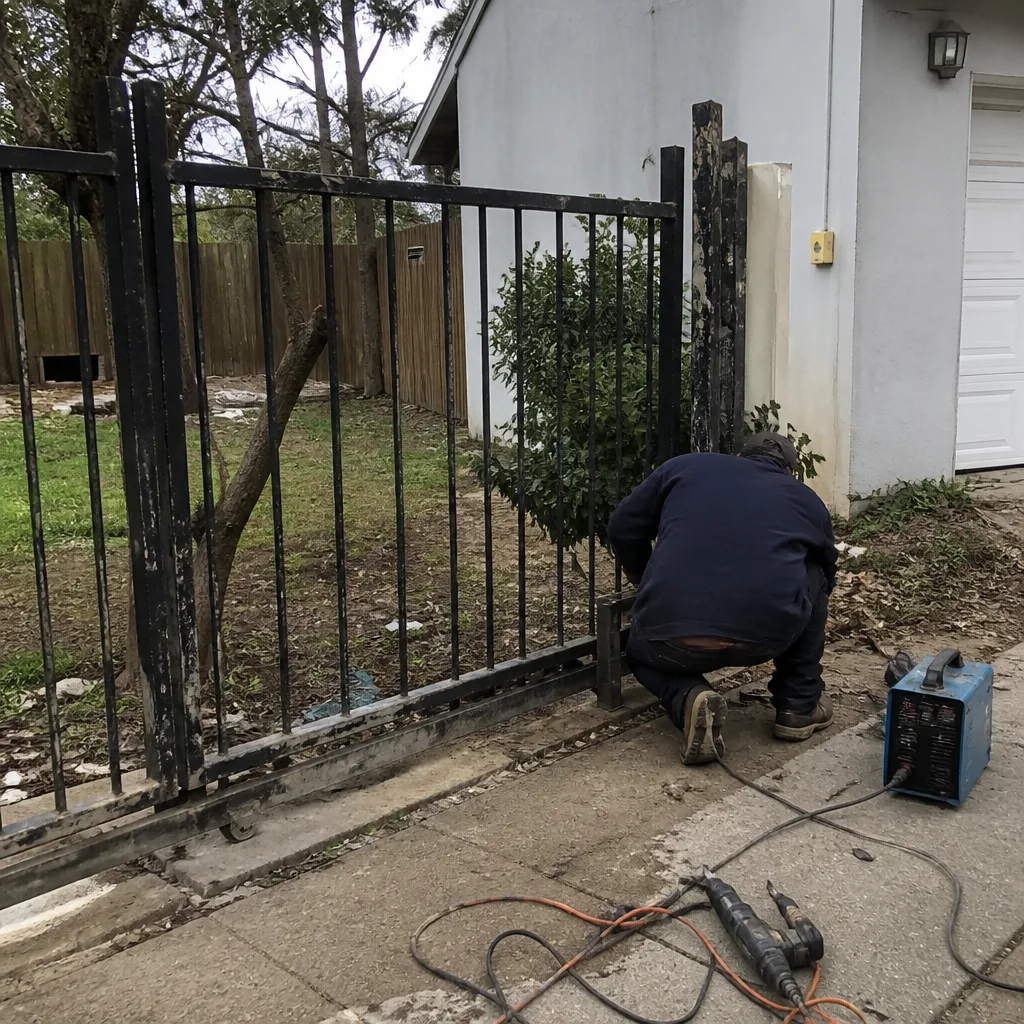 Before
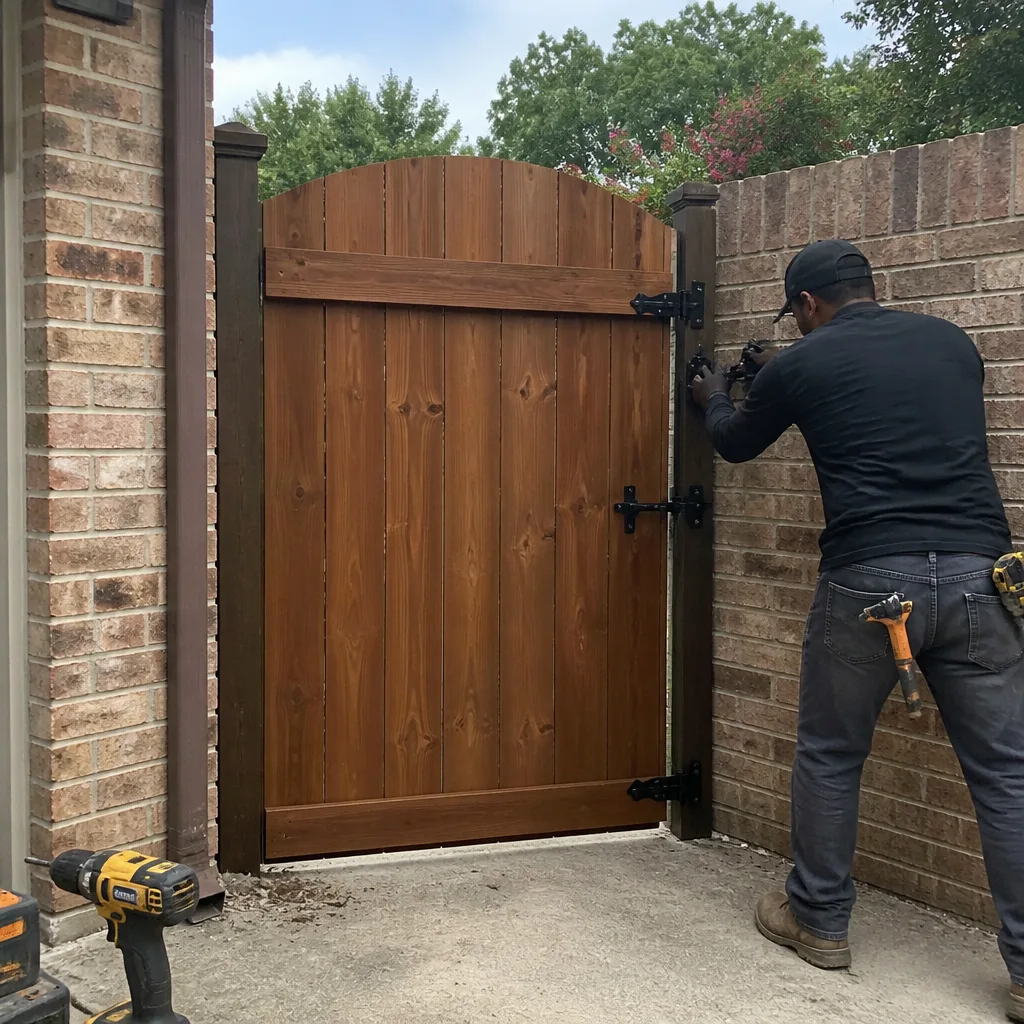 After
After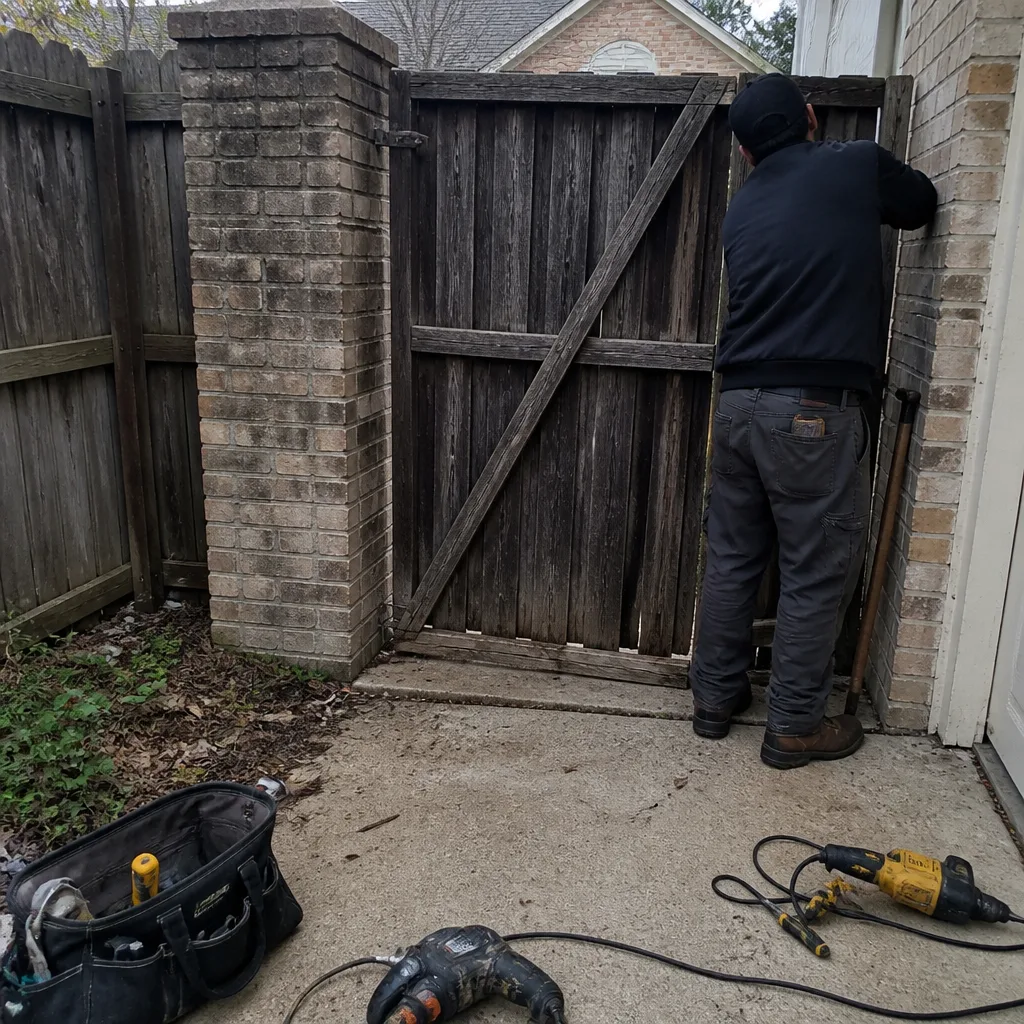 Before
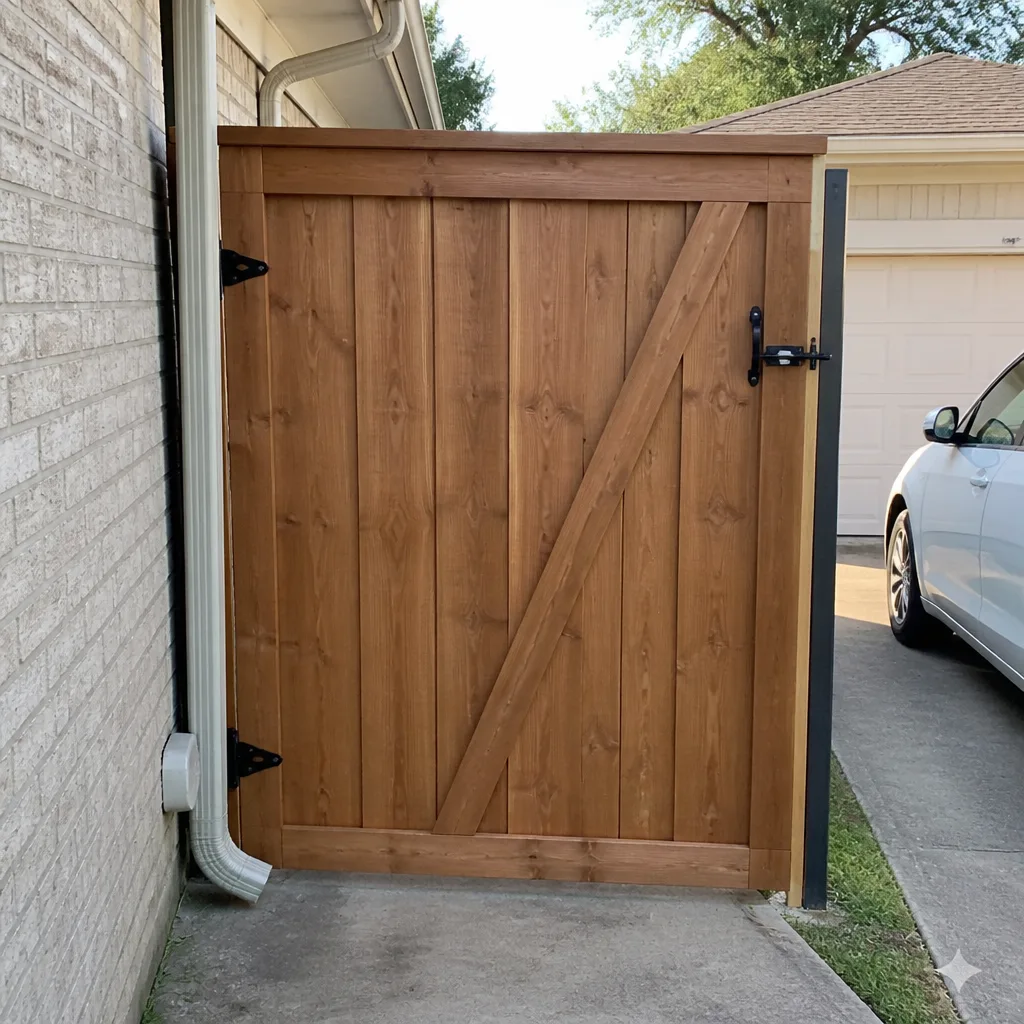 After
AfterDIY vs Professional Gate Repair: The Euless Homeowner’s Decision Guide
Here’s a number most Euless homeowners don’t expect: nearly 60% of the gate repairs we’re called to fix were made worse by a well-intentioned DIY attempt first. That’s not a knock on anyone’s handiness. Driveway gates look simple from the outside and they are anything but underneath. A gate is the largest moving object on your property, often weighing 300 to 800 pounds, and when it’s off track or the motor is fighting a bad hinge, the forces involved are enough to snap fingers, crack brick columns, or send a panel into a parked car. This guide walks you through what’s genuinely fixable on your own, what isn’t, what things cost in the Euless market, and how to know the difference before you’re standing in the driveway with a wrench and a hunch. By the end, you’ll know exactly which projects a careful homeowner with basic tools can handle, and which ones deserve a phone call to someone who does this every day.
Quick Answer
For most Euless homeowners, light maintenance like cleaning tracks, tightening visible bolts, and checking safety sensors is worth doing yourself. But anything involving gate springs, the motor or control board, welded joints, or a gate that has come off its track or out of plumb belongs with a professional, because those failures involve stored mechanical energy or heavy steel that can injure you or damage the gate further. The honest middle ground: do the simple upkeep, and call for the structural or electrical work before a $40 fix becomes a $1,400 replacement.
Table of Contents
- What Actually Fails on a Euless Gate
- DIY Projects That Are Safe and Worth Your Time
- Repairs That Belong in a Professional’s Hands
- What Gate Repair Costs in Euless
- Tools, Time, and Skill: The Honest Math
- Warranty and Insurance: What a Pro Carries, What You Don’t
- Automation and Access Control: The Electrical Side of the Gate
- Common Mistakes to Avoid
- When to Call a Professional
- Frequently Asked Questions
- The Bottom Line
What Actually Fails on a Euless Gate
Gates in Euless deal with specific conditions that accelerate wear. We’re in a climate with real temperature swings, heavy spring rain, and summers that push 100 degrees for weeks at a time. That heat-and-moisture cycle is hard on gate hardware, especially on the north side of the Metroplex where clay soil shifts enough to knock concrete posts slightly out of true. A gate that was hung level in 2005 may be fighting its own hinges by 2025 simply because the ground moved a quarter inch.
In our experience in Euless neighborhoods like Oakwood Terrace, Wilshire, and the older streets around Westpark and Midway, these are the failure points we see most, in rough order of frequency:
- Hinge wear and sagging weld joints. Iron gates are heavy. Every cycle puts load on the hinge barrels, and a hinge that wears past even an eighth of an inch of slop transfers stress into the welds at the frame corners. Most sagging gates start as “it’s dragging a little,” not as a dramatic collapse.
- Automation failures: control board, limit switches, and gearboxes. Lightning and the frequent brownouts from summer thunderstorms are notorious for killing gate opener control boards in this area. Gearboxes strip because the gate itself is binding or out of balance, forcing the motor to work like a car climbing a hill in the wrong gear.
- Track, roller, and wheel problems on cantilever and V-track gates. On sliding gates, a single jammed roller can pull the whole gate out of line and overload the motor enough to burn it. Debris, torn-up concrete seams, and tire tracks across the gate path all contribute.
- Lock and keypad issues, especially on older telephone-entry or keypad systems. Exposure to Texas sun and rain eat keypad membranes and lock cylinders. We see a predictable pattern with certain older Viking and Linear keypads: buttons go soft after five or six seasons.
- Sensor misalignment on safety edges and photo-eyes. When a gate reverses for no obvious reason, the safety loop, edge sensor, or photo-eye is usually the culprit, and that’s before you look at the board.
Knowing which of these is actually your problem saves hundreds of dollars and hours of frustration. The diagnostics are not always obvious. A gate that “won’t open” might be a dead battery in the remote, a fried board, a popped capacitor, a limit switch out of position, or a mechanical bind from a single loose hinge. The order you eliminate those possibilities is learned over years, not weekends, and that’s where a homeowner’s time really gets spent.
DIY Projects That Are Safe and Worth Your Time
There’s honest work a homeowner can do without turning a simple job into a dangerous one. These are the maintenance items that keep a gate healthy in Euless’s specific conditions, and none of them require special tools or training beyond a torque wrench, a level, some lubricant, and a willingness to get a little dirty.
1. Cleaning and lubricating the track, rollers, and hinge pins. Twice a year, ideally in spring and fall. Blow out the track with a leaf blower or compressed air, scrape any caked mud from the V-track groove, and wipe the rollers clean. Use a proper gate grease on hinge pins, not WD-40, which is a solvent and will wash the remaining lubrication out. In Euless’s heavy spring rains, a dry hinge becomes a noisy, wearing hinge within a season.
2. Tightening visible mounting bolts and checking the gate’s plumb with a level. This is a ten-minute job that prevents a lot of misery. Set your level against the gate post and the leading edge of the gate itself. If the post is out of plumb, the gate will always fight its own hinges no matter how much you lubricate or adjust. Tightening the bolts on the hinge mounting plates and the post brackets is simple, but don’t over-torque into old concrete, which crumbles.
3. Cleaning and inspecting photo-eye sensors and safety edges. These are the eyes and fingertips of your gate. Wipe the photo-eye lenses with a dry cloth, check that they point directly at each other across the gate path, and look for cracked or flattened safety edge rubbers. A safety edge that’s been run over by a tire or scorched by the Euless sun will false-trigger or fail to trigger exactly when it needs to, both of which are bad in different ways.
4. Testing the battery backup and remote batteries. Most gate openers with battery backup have a test function on the board or the wall button. Replace remote batteries once a year at the same time you change smoke detector batteries, that’s a reliable habit. Ghost Controls and BFT transmitters both use common coin cells, but confirm the size before you pull the old one.
5. Repainting surface rust or worn spots. This is prevention, not repair. Wire-brush the rust, apply a rust converter, then recoat with a good outdoor enamel or cold-galvanizing spray. A Euless gate that goes unpainted through two wet seasons will start losing metal, and painting costs a lot less than welding in a new bottom rail.
None of this work requires disabling the motor or releasing the gate from its operator, which is exactly where DIY projects get dangerous. If the gate needs to be lifted, unbolted, welded, or rewired, that’s the line where you should stop and call.
Repairs That Belong in a Professional’s Hands
This section matters. Some gate repairs are dangerous because they involve stored energy, and some are just difficult to do correctly without experience. A homeowner who understands where that line sits will save money in the long run and stay out of the emergency room.
Gate springs are the top item on the do-not-touch list. Whether you have a torsion spring, extension springs, or a counterweight system, the stored energy in a gate spring can release without warning. A torsion spring under tension can strike with enough force to break bones or worse. This is not a warning to take lightly. We have been called to Euless homes where a homeowner released a spring improperly and the spring took out the gate panel or sent a bracket through a car windshield. The rule is simple: if the spring is broken, stretched, or needs adjusting, call a professional. No exceptions.
Welding and structural crack repair. A sagging gate corner or a crack at a hinge mount means the steel has failed, and a proper repair means grinding out the crack, welding it with the correct process for the metal, and usually reinforcing the area with a gusset. This is skilled work requiring a welder, a grinder, correct amperage settings, and an understanding of how gates flex under load. A homeowner with a flux-core welder from the hardware store can make a crack look sealed while actually making the surrounding metal more brittle. We regularly repair gates in Euless that were “fixed” with poor welds that failed at the edges of the original crack within a year.
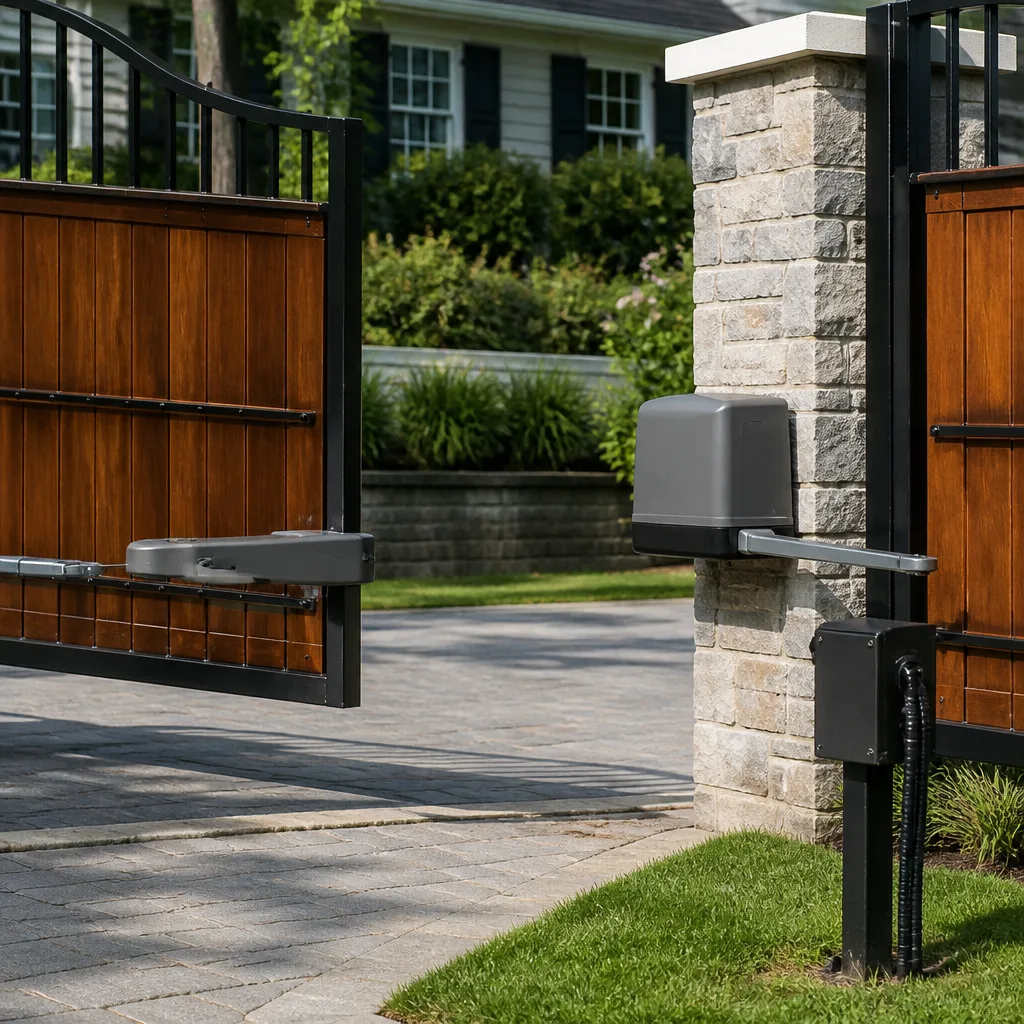
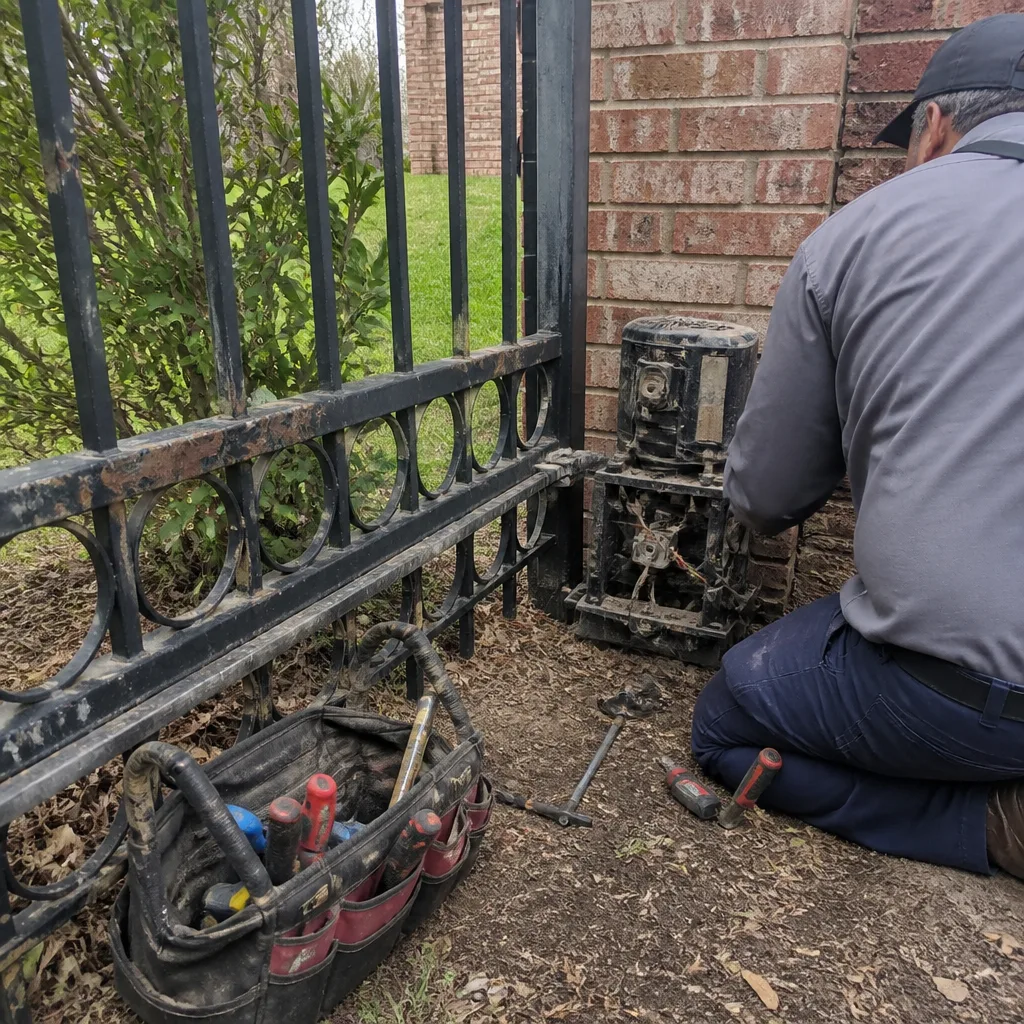
Any work on the motor, control board, or wiring. Gate opener motors run on line voltage for the main power and low voltage for controls and sensors. A wiring mistake can fry the board, create a shock hazard on a metal gate, or bypass the safety features that keep the gate from closing on a child or a pet. If the motor hums but won’t move, if the board shows an error code you can’t clear, or if you smell burning from the control box, shut off the breaker and call a pro who’s certified on your opener brand. We carry parts and training for Linear, Viking, BFT, and Ghost Controls, among others, so the right fix doesn’t wait on a second visit.
A gate off its track or out of plumb. An 800-pound sliding gate that has jumped its V-track or a swing gate that has dropped off a hinge is a hazardous situation. The gate is unstable, and trying to muscle it back into place without understanding the failure that caused it usually results in the gate falling again, often onto the person doing the lifting. This is not a judgment on anyone’s strength. It’s about a moving piece of steel that has already demonstrated it’s no longer where it’s supposed to be.
What Gate Repair Costs in Euless
Prices in the Euless market vary by the type of gate, the brand of opener, and how long the problem has been ignored. These are the ranges we see on a regular basis for common repairs, and they assume a licensed and insured contractor who quotes the job before starting work. You’ll find plenty of lower numbers from handyman services and plenty of higher ones from dealership-style national chains. The ranges below reflect a fair middle for the Euless area.
| Repair Type | Typical Cost Range in Euless | Notes |
|---|---|---|
| Hinge replacement (single gate) | $180 – $450 | Depends on gate weight and whether welding is required |
| Track/roller repair on sliding gate | $200 – $550 | Includes realignment and roller replacement |
| Control board replacement | $250 – $650 | Varies widely by brand; BFT and Linear boards trend higher |
| Gearbox or motor replacement | $350 – $900 | Includes labor and motor, varies by horsepower and brand |
| Photo-eye / safety sensor replacement | $120 – $280 | Usually same-day work |
| Keypad or access control repair | $150 – $500 | Standalone keypad vs. full telephone-entry system |
| Welding repair (crack, broken picket, gate sag) | $150 – $600 | Depends on scope; multiple cracks add up |
| Complete opener installation (new) | $1,400 – $3,500 | Includes opener, arms, safety sensors, and programming |
Three things drive these numbers more than anything in Euless. First, the brand of automation: a replacement board for a Linear opener is a different animal than one for a Viking or a BFT, and some boards are simply more expensive at the supply house. Second, accessibility: if the control box is in a tight corner behind an overgrown hedge, the labor takes longer. Third, deferred maintenance: a gate that’s been dragging for two years has usually worn through the hinge, the roller, and put strain on the gearbox, so the honest fix is three repairs at once, not one.
One thing we do at Ironworks Gate Co. and our homeowners appreciate: the price is written down and agreed to before a single bolt is turned. No one in Euless should be surprised by an invoice on a gate repair. If a contractor won’t put a quote in writing, that’s your signal to try someone else. And we offer a free second opinion on any written estimate, which has saved more than one homeowner from a repair they never actually needed.
Tools, Time, and Skill: The Honest Math
The internet makes every repair look like a twenty-minute YouTube video with a clean workspace and all the parts laid out. The driveway never looks like that. Here’s the honest math on what a “simple” gate repair actually takes, based on what we see when homeowners in Euless call us after a weekend attempt didn’t work out.
The tool problem. A proper gate repair usually requires tools most garages don’t have: a welder, an angle grinder, a right-angle drill for drilling through steel, a torque wrench in the correct range, tap and die set for stripped threads, a digital multimeter that reads millivolts for sensor circuits, and a set of specialty bits for the brand of opener involved. That’s $600 to $2,000 in equipment, most of which sits unused after the job. By contrast, a service call from a gate specialist who already owns the tools, the parts stock, and the diagnostic equipment often costs less than the tool shopping list.
The time problem. When we replace a hinge on a Euless swing gate, it takes an experienced technician one to two hours including cleanup. A homeowner doing it the first time spends a weekend: research, sourcing the correct weight-rated hinge, drilling out old bolts, discovering the post is slightly out of plumb, adjusting, readjusting, and often ending up with a gate that’s no better than when they started. If your time is worth $25 an hour, a 14-hour weekend is $350 of your own time spent producing a result you still don’t trust.
The skill problem. Gates fail in chains. A gate that drags has usually been dragging long enough to wear the hinge pins AND overload the opener gearbox AND leave the gate out of plumb. An experienced technician sees the whole chain on the first visit. A homeowner sees the dragging gate, fixes the most obvious symptom, and is back in the same spot three months later. That’s not a lack of intelligence. It’s a lack of the pattern recognition that comes from seeing hundreds of gates across Euless, Bedford, and the surrounding neighborhoods.
The parts problem. Counterfeit and generic gate parts are rampant online. We’ve pulled generic hinge rollers off gates that wore out in under a year because the bearings were unsealed and the Euless rain destroyed them. A professional sources from known supply chains and matches the part to the gate weight and cycle count, not just to the lowest eBay price.
Warranty and Insurance: What a Pro Carries, What You Don’t
This is the part nobody thinks about until something goes wrong, and it’s one of the strongest arguments for professional work.
When a licensed and insured gate company performs a repair, the work carries at least two layers of protection. The first is the contractor’s liability insurance, which covers damage to your property if something unexpected happens during the job. A welding spark that cracks a windshield, a dropped panel that dents a car, an electrical fault that damages the opener: the professional’s insurance addresses it. The second layer is the workmanship warranty. At Ironworks Gate Co., every job is protected by our 90-Day Done Right Promise in writing. If it isn’t right, we come back and make it right. No paperwork, no arguing, no exceptions. That’s a promise we’ve kept across every Euless gate we’ve touched.
When a homeowner does the work, neither layer exists. The only protection is whatever the parts manufacturer offers, and that doesn’t cover labor, doesn’t cover consequential damage, and usually requires proof of professional installation to even be honored. If a DIY repair fails and the gate falls on a car, the homeowner’s insurance may or may not cover it. If the gate closes on a visitor because a safety sensor was wired incorrectly, the liability is entirely on the person who made the modification. That’s a heavy load to carry to save a few hundred dollars.
There’s also the matter of code compliance. Euless follows Texas electrical code for gate automation, including requirements for safety photo-eyes, entrapment protection, and proper grounding. A professional installation or repair includes verification that the gate meets current safety requirements. Most homeowners don’t own the test equipment to verify that a safety edge stops and reverses the gate under the time and force limits the code specifies, and realistically, most won’t ever check. A qualified technician does, every time, before they leave the driveway.
We’ve had the uncomfortable conversation more than once in Euless: a homeowner added an opener themselves, or had a handyman do it, and the gate now lacks working photo-eyes or an operational safety edge. That’s not a gate that needs a tune-up. It’s a gate that needs correcting before it hurts someone. This is also where our free second opinion offer gets used most: we’ll look at any written estimate or any recent DIY work and tell you straight whether it’s safe and right.
Automation and Access Control: The Electrical Side of the Gate
About half the gates in Euless have some form of automation, and the percentage grows every year as more homeowners add openers for convenience. Automation may be the single area where the DIY-versus-professional decision is most lopsided.
Modern gate openers are small computers connected to powerful motors. They combine line-voltage power with low-voltage sensor inputs, limit logic, force control, radio receivers, and often battery backup. Diagnosing a problem requires knowing which part of the system is involved. A gate that opens fine but won’t close is usually a sensor issue. A gate that opens slowly is often a power or bind problem. A gate that reverses immediately after closing is a force-sensitivity or safety-edge issue. A gate that only works from the wall button but not the remote is a receiver or transmitter problem. These are not guesses an owner’s manual makes clear, and swapping parts blindly is an expensive way to troubleshoot.
Then there’s access control. Euless homeowners with intercoms, keypads, or telephone-entry systems run into failures from exposure just as often as mechanical problems. A Viking door station that’s been in Texas sun for a decade may have a failing keypad membrane or a blown speaker. A keypad on a BFT system may have a dead relay that prevents the gate from opening even though the display lights up. Diagnosing these issues requires a multimeter, a wiring diagram, and brand-specific knowledge. We’ve been certified on nine major opener brands, including BFT, Linear, Viking, and Ghost Controls, which means one visit from us replaces the “guess and order parts” cycle a homeowner might go through over several weeks.
One thing worth saying clearly: if you’re installing a new opener or automating an existing gate, that is never a DIY job. The code requirements for entrapment protection are not optional, the electrical work carries shock and fire risk, and a gate that moves under motor power when it previously didn’t will quickly reveal every weakness in the hinges, the post, and the gate’s balance. A proper installation includes evaluating and correcting those issues so the new motor isn’t destroyed within a year by a gate it was never meant to drag.
Our $89 Seasonal Tune-Up has become popular with Euless homeowners who want their automated gate checked before the extremes of summer heat or the heavy rain of spring. It’s a low-cost way to catch a wearing gearbox or a weakening battery before it becomes a stranded car in the driveway at 6 a.m.
Common Mistakes to Avoid
After four decades of working on gates in the Dallas-Fort Worth area, we’ve seen the same mistakes repeat across Euless driveways. Most are avoidable with a little knowledge and a lot of respect for the equipment.
- Using WD-40 or motor oil on hinges and rollers. These products wash out the existing grease and attract dust, turning the hinge into a grinding paste. Use a dedicated gate grease or lithium-based lubricant. In Euless’s wind and dust, oiled hinges seize faster than dry ones.
- Adjusting a torsion spring without the correct winding bars. A screwdriver or a piece of rebar in a tensioned spring is how people get hurt or killed. If the spring needs adjustment, call someone who does it with proper tools and experience.
- Ignoring “it’s dragging a little” for more than a season. A dragging gate wears the hinge, the roller, and the gearbox at once. The $200 fix becomes $900 in parts and labor after two years of “I’ll get to it.” In clay-heavy areas of Euless where concrete shifts, the drag gets worse by itself, never better.
- Replacing the opener before checking the gate itself. A new motor on a gate that binds or sags will strip the new gearbox within a year. About a third of the opener replacement estimates we review are actually gate-mechanical problems wearing out the motor. Fix the gate first, then decide if the motor survives.
- Buying generic parts from online marketplaces. Unsealed bearings, soft steel hinges, and counterfeit control boards fail quickly, often on gates where a failed part causes property damage. If a hinge rated for 400 pounds costs $9, it isn’t rated for 400 pounds.
- Disabling a safety sensor to “make it stop reversing.” When a gate keeps reversing, it’s usually because the photo-eye, safety edge, or force settings are telling the system something is in the way. Bypassing that safety system solves the symptom and creates a real hazard for children, pets, and delivery drivers. Never jumper or bypass a safety input on a gate opener.
- Believing the gate is “just a big door” that any general handyman can fix. Gate repair involves welding, specific automation brands, code requirements, and hundreds of pounds of moving steel. A generalist may genuinely try their best, but gates have a way of punishing approximations. Euless homeowners who call us after a handyman repair usually pay twice: once for the first attempt, once to have it undone and done right.
When to Call a Professional
There’s a point where continuing to work on a gate yourself stops being thrift and starts being risk. Call a professional when the gate has come off its track or dropped on its hinges. Call when the spring is broken, stretched, or making popping sounds under tension. Call when the motor hums but won’t turn, the control board is smoking or displaying an error, or the breaker trips the moment the opener tries to move. Call when you see a crack in the steel at a hinge or a weld point, or when a gate that used to be quiet starts groaning like a wounded animal. Call when the gate stops a foot short, reverses unexpectedly, or won’t stay closed. None of these are weekend projects. Ironworks Gate Co. home base is here in the area, and we offer free estimates in Euless. Call (806) 484-1837, tell us what the gate is doing, and we’ll give you an honest read on the phone before we ever set foot in your driveway.
Frequently Asked Questions
Most gate repairs in Euless run between $150 and $900 depending on the repair type, with common jobs like hinge replacement and board replacement falling in the $180 to $650 range. The most expensive repairs usually involve replacing a complete opener or addressing structural damage that’s been ignored for years. Call (806) 484-1837 for an exact quote. Estimates are free, and the price is agreed to before any work starts.
It is not safe for most homeowners to repair a gate opener, because the work involves line voltage, stored mechanical energy, and safety systems that prevent injury when working correctly. A wiring error can create shock risk and can also leave the gate without functional entrapment protection. If the problem is beyond replacing a battery or cleaning a sensor lens, call a professional.
Homeowners can safely handle cleaning the track and rollers, lubricating hinge pins, tightening visible mounting bolts, cleaning and aligning photo-eye lenses, replacing remote batteries, and touching up surface rust. These are maintenance tasks. Anything involving springs, welding, motor internals, wiring, or a gate off its track should be left to a professional.
A gate that reverses or stops halfway is usually responding to a safety input: a misaligned photo-eye, a cracked safety edge, or force settings that are too sensitive for the gate’s weight and balance. It can also be a limit switch out of position or a control board fault. You can start by cleaning the photo-eye lenses and checking that they’re aligned, but if it continues, the issue is deeper and needs a technician.
In the Euless climate, with summer heat and spring thunderstorms, a properly installed quality opener like a BFT, Viking, Linear, or Ghost Controls typically lasts 10 to 15 years with regular maintenance. Opener life drops sharply when the gate itself is out of balance or binding, because the motor wears itself out against a load it was never designed to sustain. Our $89 Seasonal Tune-Up helps catch the bind before it eats the gearbox.
Most gate repairs and replacements do not require a permit in Euless, but new electrical runs for automation and access control may be subject to Texas electrical code and local requirements. A licensed professional handles that determination as part of the quote. When in doubt, ask your contractor to verify that the work complies with current code. We do this on every automation job we perform.
The Bottom Line
Gates are forgiving until they aren’t. The maintenance side, cleaning, lubricating, checking sensors, touching up rust, is honest work a careful homeowner can and should do. The repair side, springs, welds, motors, boards, a gate that’s off track, is where experience and the right tools earn their keep. What starts as a tight budget in the Euless driveway often ends as a bigger repair bill after a frustrated Saturday and a part sourced from the wrong end of the internet. If the gate is misbehaving and you aren’t sure which category you’re in, call (806) 484-1837. We’ll talk you through it, tell you straight whether it’s a DIY job or not, and if it isn’t, we’ll quote you a fair price in writing before we turn a single bolt. Done right, and backed in writing.
Written by Victor Salinas, Owner at Ironworks Gate Co., serving Euless since 2013.