
Quick Summary
Faulty automatic driveway gate sensors disrupt property access and present serious entrapment hazards caused by expansive soil movement, optical sun blinding, and weather-related electrical damage. Ironworks Gate Co. provides rapid same-day driveway gate sensor repair in Euless, utilizing precise electrical diagnostics and transparent upfront pricing to resolve photo-eye and ground loop failures without pushing unnecessary replacements. Property owners will understand how to identify common sensor failure symptoms and can schedule an on-site safety diagnostic to restore reliable gate operation.
Driveway Gate Sensor Repair in Euless
When an automated driveway gate suddenly stops, reverses halfway through its cycle, or stays locked open, the safety sensors are usually the culprit. Gate operators work continuously to secure properties and maintain access. A dependable gate is necessary for security and daily schedules.
Ignoring a malfunctioning sensor is an active safety hazard. According to federal safety data, automatic gates can cause serious injuries, including cuts, broken bones, hematomas, and amputations. Faulty photo-eyes and non-responsive safety loops can lead to severe accidents, making proper diagnosis from specialists like Ironworks Gate Co. essential to determine whether an issue stems from optical misalignment, wiring faults, or environmental interference.[3]
Why Driveway Gate Sensors Fail
While dirt and debris can block optical beams, gate operators face various environmental and mechanical stresses that require a technical troubleshooting approach.
Expansive Soil and Bracket Deflection (General Technical Guidance)
As general technical guidance, ground movement from expansive clay soil can shift gate posts, fence lines, and mounting brackets over time. Even a slight structural shift across a driveway span may move an infrared beam out of alignment with its receiver or reflector, triggering an obstacle fault that prevents the gate from closing.[4]
Low-Angle Sun Blinding and Heat Reflection
East-facing and west-facing driveways can experience optical blinding during sunrise and sunset. When low-angle sunlight strikes an infrared receiver directly, the optical sensor can become saturated with natural light, rendering it temporarily unable to read the signal from the transmitter.
Storm Damage, Lightning Surges, and Conduit Moisture
Texas is frequently identified as a national leader in severe hail exposure. In addition, electrical storms and lightning can send voltage spikes through low-voltage lines, damaging sensitive relay contacts inside photo-eyes and loop detector modules. According to technicians at Ironworks Gate Co., heavy rainfall can also introduce moisture into cracked conduits or unsealed junction boxes, leading to ground faults and power interruptions.[1]
Photo-Eyes vs. Induction Loops vs. Safety Edges
Modern automated gate systems use a combination of safety devices to meet standard safety requirements. Each device performs a specific function and requires distinct diagnostic methods.
| Device Type | Primary Function | Common Failure Cause | Diagnostic Method |
|---|---|---|---|
| Photo-Eye Sensors | Entrapment protection across the drive path | Sun blinding, post shift, cracked lenses | Optical alignment tool, multimeter voltage test |
| Inductive Ground Loops | Vehicle detection for auto-open or safety hold | Pavement cracking, moisture intrusion, wire breaks | Megohmmeter insulation test, loop frequency meter |
| Contact Safety Edges | Physical obstruction reversal on gate frame | Worn pressure switches, torn rubber, damaged wiring | Continuity and resistance testing |
Diagnosing Infrared Optical Safety Beams
Monitored photo-eyes require a steady power supply and a continuous signal return to the main control board. When troubleshooting these units, technicians at Ironworks Gate Co. check input voltage at the receiver terminals, verify relay operation when the beam is broken, and ensure proper optical alignment across the driveway opening.[5]
Testing In-Pavement Loop Detectors (General Technical Guidance)
Ground loops are sealed into saw-cut channels within concrete or asphalt driveways. As general technical guidance, technicians test wire insulation resistance to ground using a megohmmeter to identify moisture leaks or wire degradation inside the pavement cut, adjusting detector frequencies as needed to avoid interference.
Operator Diagnostics (General Technical Guidance)
Need driveway gate sensor repair euless?
We’re available now - call for a fast, free estimate.
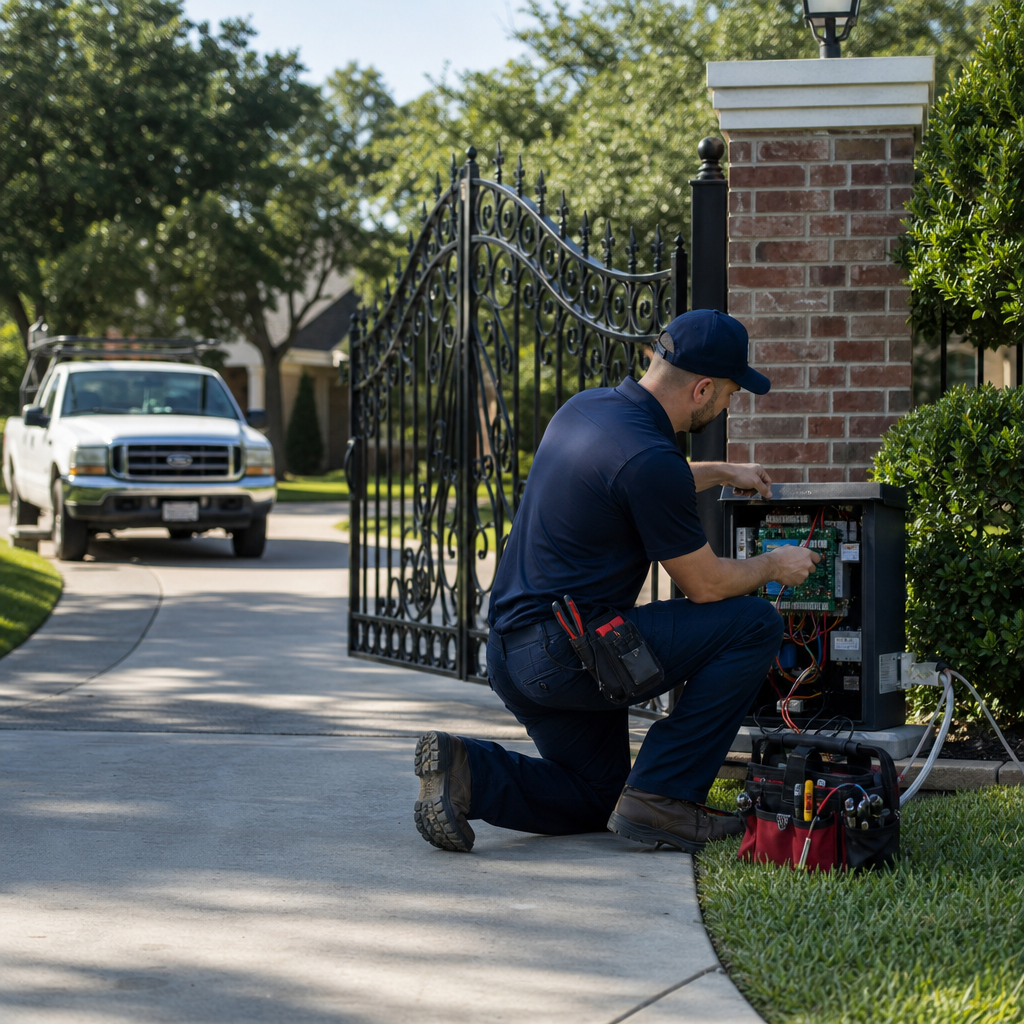
As general technical guidance, many gate operators use onboard diagnostic LEDs to communicate sensor and safety circuit faults:
- LiftMaster / Chamberlain: Diagnostic LEDs typically flash specific codes to indicate whether an entrapment device has lost communication, short-circuited, or shifted out of alignment.
- DoorKing (DKS): Dedicated safety input LEDs indicate active safety signals or open circuits in the sensor wiring harness.
- Apollo / Nice: Control boards monitor current and input status, signaling faults when voltage drops or open circuits occur.
Estimated Driveway Gate Sensor Repair Costs
As a broad regional estimate, professional sensor or photo-eye repair typically ranges from about $150 to $300. This generally covers diagnostic evaluation, beam realignment, lens cleaning, or minor wiring repairs.
More extensive repairs, such as replacing damaged underground induction loops or installing new low-voltage conduit, vary based on distance and pavement conditions. A qualified technician from Ironworks Gate Co. will test system voltage and circuit integrity to determine which components need service or replacement.
Frequently Asked Questions
Why is my driveway gate sensor blinking and preventing the gate from closing?
A blinking LED on a gate sensor or control board generally indicates that the infrared safety beam is interrupted or misaligned. The operator interprets this as an obstruction and holds the gate open to prevent damage or injury. Common causes include shifted mounting brackets, dirt on the lens, direct sunlight blinding the receiver, or damaged low-voltage wiring.
How much does driveway gate sensor repair cost?
Broad regional estimates for gate sensor or photo-eye repair generally range from about $150 to $300 for standard diagnostics, bracket realignment, and wiring fixes.
How do I know if my gate photo-eye sensors are misaligned or broken?
Many sensor models feature status indicator LEDs on the transmitter and receiver units. An illuminated LED usually indicates normal alignment and power, whereas a dark or flashing LED often points to misalignment, power supply issues, or an internal component failure.
Can dirt, sun glare, or moisture cause automatic gate sensor failure?
Yes. Low-angle sunlight can overwhelm the infrared receiver, simulating an obstruction. In addition, moisture inside unsealed enclosures or dirt and mud on the optical lenses can disrupt the safety circuit and halt operation.
How quickly can a technician repair or replace driveway gate sensors?
As noted by Ironworks Gate Co., repair time varies depending on the specific fault, whether parts require replacement, and whether the issue involves simple optical realignment or extensive underground loop troubleshooting.
What are the safety risks of operating an automatic gate with faulty sensors?
Operating an automatic gate with malfunctioning safety sensors creates severe entrapment hazards. Federal safety data indicates that automatic gates can cause serious injuries, including cuts, broken bones, hematomas, and amputations. Functional monitored safety sensors are critical to ensure gates stop and reverse when an obstruction is present.[2]
Need driveway gate sensor repair euless?
We’re available now - call for a fast, free estimate.
Sources
- Storm Events Database – Search Page – ncei.noaa.gov (2025)
- Estimated Injuries Occurring in 2020 and Estimated Deaths – cpsc.gov (2020)
- New Safety Standard for Automatic Security Gates Helps … – cpsc.gov (2000)
- [PDF] Trends and Insights: Texas: A Complex Mix of Risks – iii.org (2025)
- Standards for the Hidden Dangers of Gates – ASTM – astm.org (2024)
Frequently Asked Questions
Can I safely bypass a malfunctioning gate sensor to close my gate?
Monitored automatic gate operators require active safety signals to function, meaning bypassing a sensor creates severe entrapment hazards and violates safety codes. If your gate is stuck open, switch the unit to manual release mode and contact Ironworks Gate Co. for same-day sensor repair in Euless.
How do technicians fix sun glare blinding on infrared photo-eye sensors?
Technicians from Ironworks Gate Co. resolve optical sun blinding by installing protective sensor hoods, realigning mounting brackets, or swapping the transmitter and receiver positions across the driveway. This prevents intense low-angle sunlight at sunrise or sunset from saturating the infrared optical beam.
How does expansive soil in Euless affect driveway gate sensors?
Shifting clay soil tilts gate posts out of optical alignment and cracks driveway pavement, which allows moisture to degrade underground loop wires. Ironworks Gate Co. conducts megohmmeter insulation tests and reinforces mounting brackets to keep your sensors resilient against ground movement.
About the author
 |
Marcus Caldwell Marcus Caldwell is a perimeter security specialist with over eight years of experience in access control systems and automated gate solutions. He frequently writes about residential and commercial gate maintenance, focusing on practical troubleshooting and cost-effective repair strategies for property owners in the DFW metroplex. Marcus holds a certification in Automated Gate Systems Design from the American Fence Association. |
Gate not opening, off track, or opener dead?
We’re available now - call for a fast, free estimate.
Call Now - Free Estimate