
Quick Summary
When addressing a dragging driveway gate caused by expansive clay soils or dynamic operator loads, learning how to fix a sagging gate post prevents severe mechanical binding and costly opener damage. Ironworks Gate Co. demonstrates that targeted structural solutions, such as welded steel gusset reinforcement or footing reconstruction, effectively restore plumb alignment without the expense of a full gate replacement. Property owners will learn how to evaluate hardware wear and foundation displacement through practical diagnostic steps to determine whether simple hinge adjustments or specialized repairs are required.
Fix Sagging Gate Post: Same-Day Repairs in Euless, TX
When you need to fix a sagging gate post in Euless, a complete tear-out and gate replacement is not always the only solution. Post realignment, footing reconstruction, or welded reinforcement represent general repair options that require professional assessment to restore gate swing and track clearance without necessarily replacing the entire system.
When an automatic or manual gate drags against the driveway, issues may originate below the surface. Expansive soils shrink and swell with moisture changes and can contribute to settlement, heave, or lateral disturbance around embedded gate posts. In addition, operator torque and repeated cycling may act as possible contributing loads that pull posts out of plumb over time. Practical repair options, as noted by specialists like Ironworks Gate Co., often target the post base, footing depth, and hinge mounts depending on professional evaluation.[1]
Available research does not establish validated percentages for how often loose posts, soil movement, hinge failure, overloaded gates, or wind cause sagging.[4]
Diagnostic Checklist for a Sagging Gate Post
A sagging driveway gate post can compromise property security and place strain on automatic gate systems. Before starting repairs, an assessment helps isolate whether the issue involves hardware wear, physical post deformation, or subterranean footing displacement.
Quick Diagnostic Steps
- Check mechanical hardware: Inspect hinges, flange brackets, and threaded J-bolts for wear or play. Minor leaf drop may sometimes be corrected by adjusting threaded hinge pins.
- Inspect the groundline: Check the junction where the post enters the concrete collar as a key inspection point. Testing by the Texas Transportation Institute reported that wood posts fractured at the groundline and steel posts twisted and yielded without significant translation. Inspect for potential cracks in the concrete footing, rust or corrosion at the groundline, or decayed wood fibers.
- Measure post plumb: Place a level on both the interior and exterior faces of the post. If the post and footing collar tilt together, the issue may involve surrounding soil support or footing depth rather than loose hardware.
- Inspect operator connection points: Check where the linear actuator or articulating arm connects to the post bracket. Operator torque and repeated cycling are possible contributing loads that can place twisting stresses on post assemblies over time.
Immediate Action vs. Long-Term Stabilization
When assessing a sagging gate, releasing the manual clutch or disconnecting the operator arm can prevent added strain on the drive mechanism. While adjusting hardware may temporarily restore clearance, an out-of-plumb post associated with soil movement or heavy gate loads generally requires structural reinforcement or footing assessment to address recurring issues.[3]
Why Gate Posts Sag: Soil Movement and Dynamic Loads
Need fix sagging gate post?
We’re available now - call for a fast, free estimate.
Gate posts can lean due to several interacting factors, including soil movement around footings and mechanical forces from the gate leaf and operator.
Expansive Soil Movement
Expansive soils shrink and swell with moisture changes and can contribute to settlement, heave, or lateral disturbance around embedded gate posts. Cyclical ground movement can affect concrete footings, particularly when supporting heavy gate leaves extending outward from the hinge axis.[2]
Operator Torque and Cycling
Automatic gate openers deliver starting and stopping torque during operation. In high-use settings, repeated cycling and dynamic operator torque can serve as possible contributing loads that place ongoing stress on post assemblies and footings.
Wind Load and Structural Considerations
Gate posts experience structural demand from gate weight and wind forces. Embedded-post design requirements generally increase with greater wind force and higher applied loads, especially on solid or high-infill gate designs that capture significant wind pressure.[5]
How a Leaning Post Affects Hinges, Rollers, and Gate Openers
A gate post that tilts out of plumb can transfer unintended loads and resistance across the entry system.
Hinge Binding and Wear
Gate hinges operate best along a plumb vertical axis. When a post tilts, uneven tension and compression can accelerate friction and wear on hinge components and mounting hardware.
Operator Resistance
When posts lean, automatic operators may encounter increased mechanical resistance, which can contribute to motor strain, safety sensor reversals, or wear on internal drive components.
Slide Gate Alignment
On sliding gates, a leaning post can affect alignment by causing guide rollers, drive chains, or tracks to bind or experience uneven wear.
How to Reinforce and Straighten a Sagging Metal or Wood Post
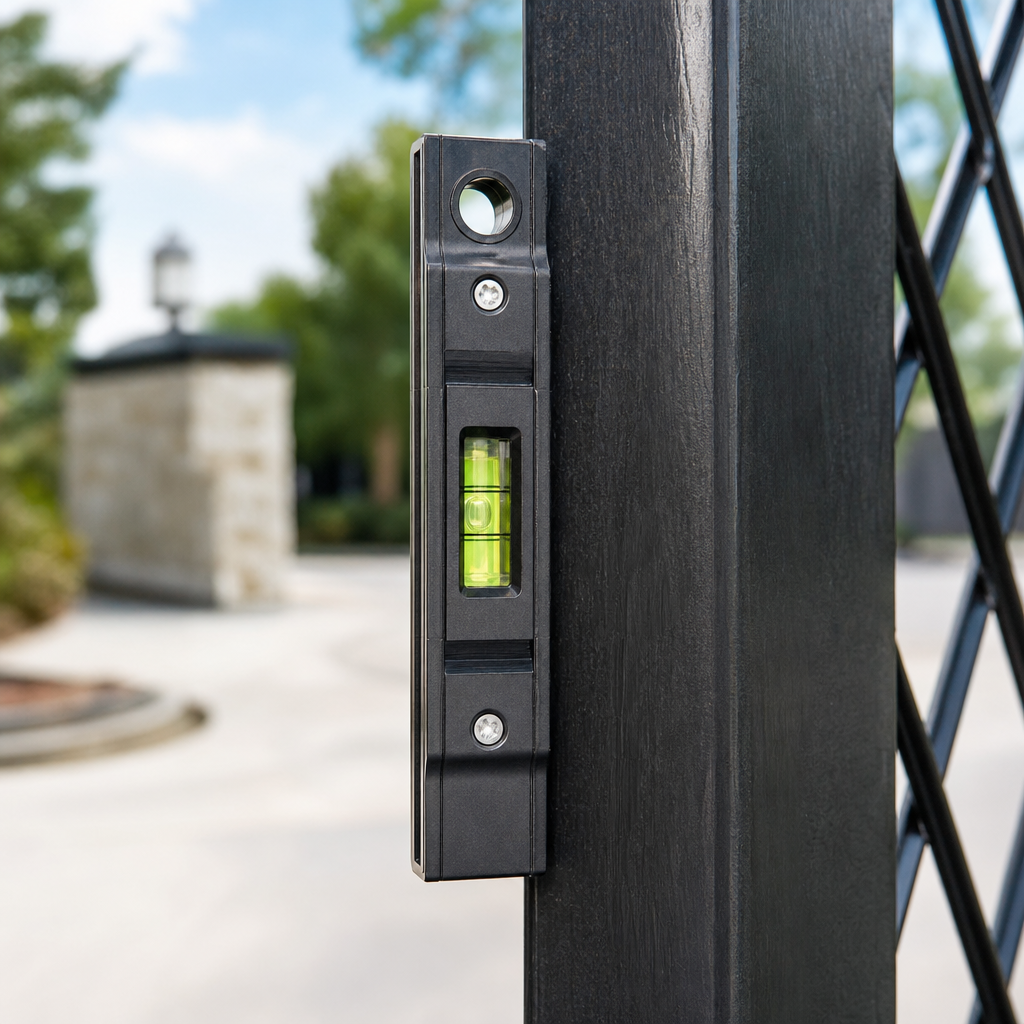
Fixing a sagging gate post typically involves evaluating both above-ground alignment and the foundation below grade. The appropriate method depends on whether the post material has yielded or the concrete footing has shifted, requiring professional assessment to determine suitability.
Adjustable Hinge Tuning
When the post remains plumb and the gate leaf has dropped due to minor hardware shifting, adjusting threaded J-bolts can help restore latch alignment as a maintenance measure.
Excavating and Resetting the Footing
If a concrete pier has shifted due to soil disturbance, resetting the footing is a general option:
- Disconnect the operator arm and properly support the gate leaf.
- Excavate around the displaced footing to inspect foundation depth and relieve pressure.
- Realign the post to plumb.
- Reconstruct or enlarge the footing according to site-specific soil conditions and load requirements.
Steel Sleeving, Gussets, and Reinforcement
Where a steel post has experienced bending at the base while the footing remains stable, structural reinforcement methods may be evaluated by a professional from Ironworks Gate Co.:
- Internal or External Steel Sleeving: Installing a structural steel sleeve over or inside the existing post section to add strength.
- Gusset Plates: Adding welded gusset plates to stiffen the post base against lateral and rotational forces.
- Bracing: Adding diagonal support or secondary bracing to stabilize the hinge post.
Note: The following table provides general, non-researched guidance on common repair approaches.
| Repair Approach | General Soil Movement Resistance | General Mechanical Load Support | Common Application |
|---|---|---|---|
| Turnbuckle / Anti-Sag Brace Kit | Low | Low | Lightweight gate frame adjustments |
| Concrete Footing Reset and Deep Pier | High | High | Footings shifted by expansive soil movement |
| Steel Sleeve, Base Plate, and Gusset Reinforcement | Moderate to High | High | Post base deformation with sound footing |
What Does Fixing a Sagging Gate Post Cost?
Need fix sagging gate post?
We’re available now - call for a fast, free estimate.
The cost to fix a sagging gate post varies based on the root cause and required repair approach. Total costs and service availability depend on specific inspection findings and local provider arrangements.
Primary Cost Factors
- Scope of structural work: Hardware adjustments generally require less labor than excavating concrete footings or performing structural welding.
- Post material: Heavy-gauge steel or specialty materials typically involve higher replacement or reinforcement costs than standard wood posts.
- Site conditions: Excavating near paved driveways, conduit, or compacted soil can impact labor requirements.
- Operator adjustment: Testing and adjusting travel limits and safety features may be necessary after post realignment.
Repair vs. Replace Considerations
If the gate leaf and structural framework remain in serviceable condition, repairing or reinforcing the post base or footing can often resolve the issue without replacing the entire gate system.
Automatic Gate System Alignment
Maintaining proper vertical alignment on automated gate posts helps ensure smooth operation across the system by reducing mechanical binding and unneeded strain on drive mechanisms.
Protecting Motors and Controls
When posts are properly aligned, gates are less likely to bind or trigger obstruction reverses, supporting normal operation of the drive system.
Hardware Considerations
Selecting appropriate heavy-duty hinges and guide rollers suited to the gate weight can reduce operating friction and assist in maintaining overall system alignment.
Frequently Asked Questions About Sagging Gate Post Repair
How much does it cost to fix a sagging gate post in Euless, TX?
Costs vary depending on whether the solution involves hardware adjustment, post reinforcement, or footing excavation and reconstruction. Pricing and service availability depend on inspection findings and local provider arrangements.
Can a leaning metal gate post be straightened without digging it up?
In some cases, if the concrete footing is stable and the lean is limited to the post above grade, professional reinforcement options such as sleeving or gusseting may be considered. If the footing itself has shifted in the soil, excavation and resetting may be required.
How should I handle an emergency gate post failure?
Disengage the automatic gate operator using the manual release mechanism to avoid mechanical strain. Secure the gate leaf to prevent it from causing an obstruction or hazard, and contact a qualified gate professional like Ironworks Gate Co. for an evaluation based on provider availability.
Does a sagging post affect gate operator performance?
A sagging post introduces mechanical resistance and misalignment that can place added strain on gate operators and drive mechanisms. Realignment helps ensure that the gate moves freely within its intended operating parameters.
Need fix sagging gate post?
We’re available now - call for a fast, free estimate.
Sources
- Residential House Foundations on Expansive Soils in Changing Climates – huduser.gov (2021)
- [PDF] IHB TB 10-01 - Foundations on Expansive Soils – tdlr.texas.gov (2005)
- Soils - Expansive Soil – Prince William County – pwcva.gov
- isgsr 2011 template – library.geosyntheticssociety.org (2011)
- Design and Structural Analysis of Gates and Hoisting Systems … – globaljournals.org
Related reading: How to Fix Sagging Gate Post – Call Now-10% Off – Same-Day Service – Free Estimate
Related reading: Automatic Gate Sensors | Call Now-10% Off | Same-Day Service | Free Estimate
Related reading: Driveway Gate Sensor Repair Euless | Call Now-10% Off | On-Site in 60 Minutes | Free Estimate
Frequently Asked Questions
How deep should a replacement gate post footing be to prevent sagging in expansive clay soil?
To counteract shifting clay soils, gate post footings typically need to extend 36 to 48 inches deep, past the active moisture zone. Ironworks Gate Co. designs widened or bell-bottom concrete piers tailored to local soil conditions to ensure long-term stability against ground heave.
How do I know if my sagging post can be reinforced with steel gussets instead of being dug up?
Welded steel gussets and internal sleeving work best when the post has bent at the groundline while the concrete footing remains stable and plumb. If placing a level against the concrete collar reveals that the entire foundation has tilted in the soil, the footing must be excavated and reset.
Can a sagging gate post permanently damage an automatic gate opener?
Yes, an out-of-plumb post causes severe hinge binding and resistance that overworks the operator drive motor and internal gears. This friction leads to premature motor burnout, stripped drive tracks, and frequent obstruction sensor errors until alignment is restored.
About the author
 |
Marcus Caldwell Marcus Caldwell is a perimeter security specialist with over eight years of experience in access control systems and automated gate solutions. He frequently writes about residential and commercial gate maintenance, focusing on practical troubleshooting and cost-effective repair strategies for property owners in the DFW metroplex. Marcus holds a certification in Automated Gate Systems Design from the American Fence Association. |
Gate not opening, off track, or opener dead?
We’re available now - call for a fast, free estimate.
Call Now - Free Estimate